Japan's palm kernel shells (PKS) imports rose in July as more biomass plants started up.
The country imported 145,000t of PKS in July, a 68pc increase from June and 59pc up on July 2018, according to finance ministry data. And total PKS import figures could be higher than this, as importers occasionally use an alternative customs code when they import PKS to Japan.
Japan's PKS demand grew in July as industrial gas supplier Air Water and utility Chugoku Electric Power's co-firing power plant in Hofu, Yamaguchi prefecture and utility Chubu Gas' Higashi-Mikawa biomass power plant in Toyohashi, Aichi prefecture began operations in the month. The Hofu plant burns 50pc biomass — including locally sourced timber from forest thinning and imported PKS — and 50pc coal, while the Higashi-Mikawa plant burns 140,000 t/yr of imported PKS, alongside 10,000 t/yr of domestically sourced woody biomass.
Indonesia remained the primary PKS supplier to Japan in July, accounting for 105,000t, or 72pc of the total volume. The total was up by 49pc and 48pc on the month and year, respectively. But Indonesia's share fell slightly from 77pc in July 2018.
Indonesia's PKS stocks remained tight in July, as low crude palm oil prices discouraged mills from increasing production, slowing fresh fruit bunch collection. As a result, Japanese buyers increased purchases of Malaysian PKS.
Japan imported 40,000t from Malaysia, up by 155pc on the month and 94pc on the year. Malaysia's share of Japanese import demand rose to 28pc in July, up from 23pc in July 2018. Japan took 100t of PKS from Thailand in July.
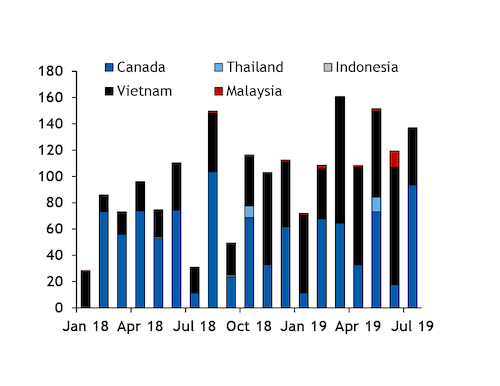
Wood pellet demand continues to growJapan imported 137,000t of wood pellets in July — up by 15pc on the month and more than triple the 39,000t imported a year earlier.
Canada was the largest supplier of wood pellets to Japan in July, with 93,000t or 68pc of the monthly total. But the north American exporter remained the second overall supplier to Japan in the first seven months of the year. The frequency and consistency of deliveries from Canada varies because most of Japan's power plants have storage constraints and cannot receive cargoes in consecutive months.
Canadian shipments tend to arrive in Handysize vessels capable of holding 25,000-35,000t, unlike Vietnam, which can provide more regular coaster shipments of 7,000-10,000t.
In fact, Canada's share of Japan's wood pellet imports from January-July shrank to 41pc this year, from 66pc for the same period 2018. Meanwhile, Vietnam grew its share to 52pc in January-July this year, up from 29pc a year earlier.
Japan took 42,000t of wood pellets from Vietnam in July, down by 52pc on the month, but more than double the amount of a year earlier.
Japan received small amounts of wood pellets from other Asian countries in July — almost 800t from Malaysia, 400t from Indonesia and 100t from Thailand.
Japan's PKS imports '000t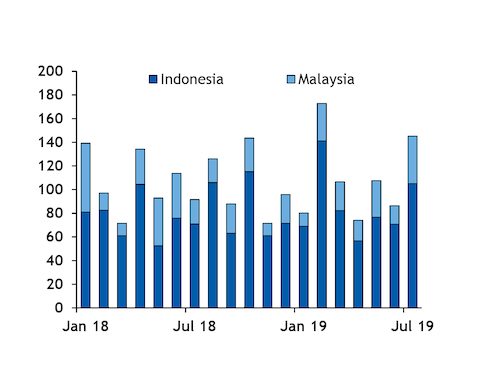 Japan's wood pellet imports '000t